


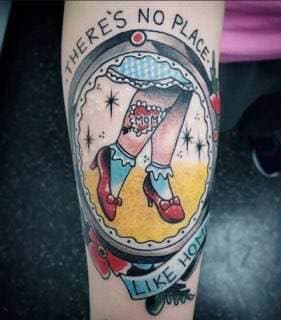


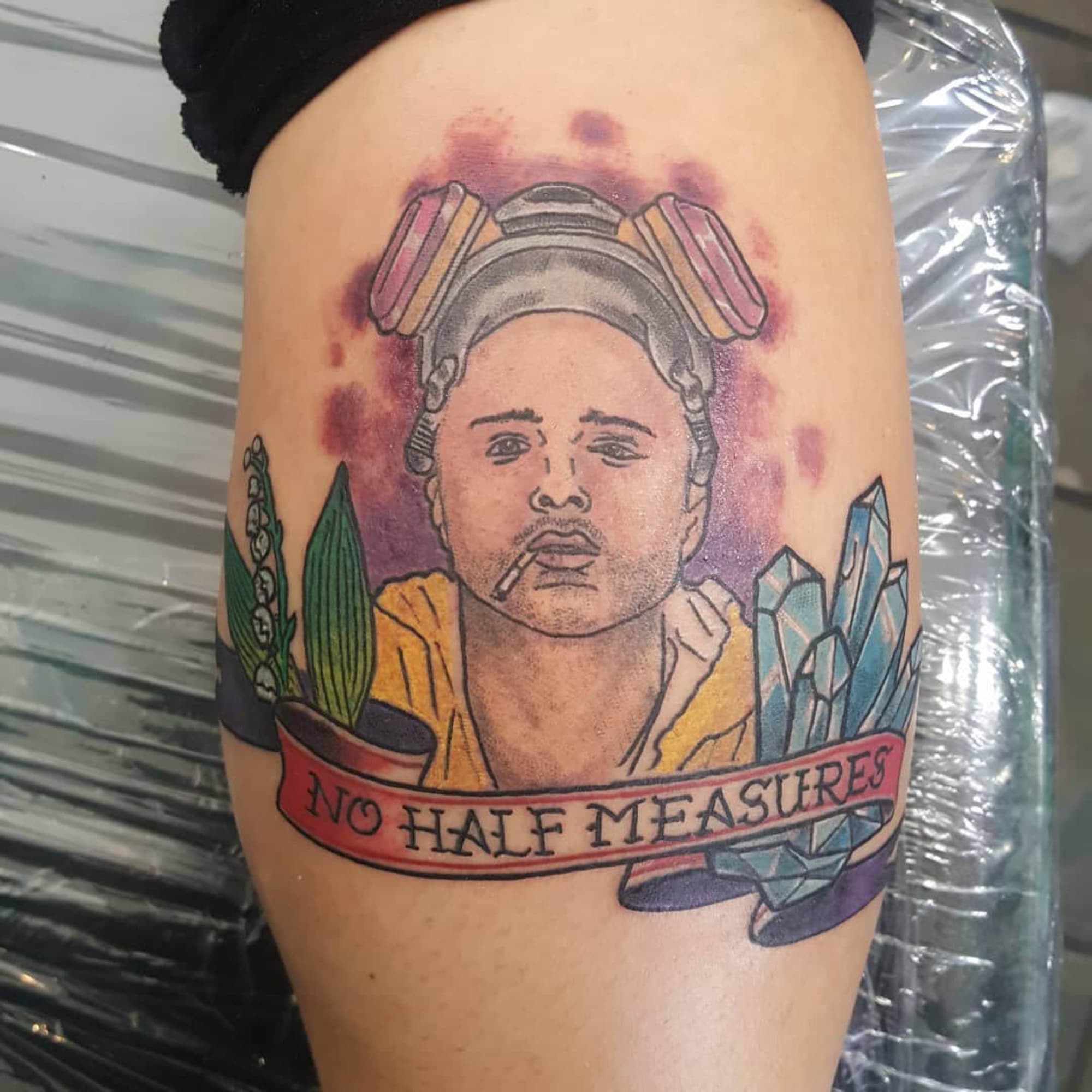
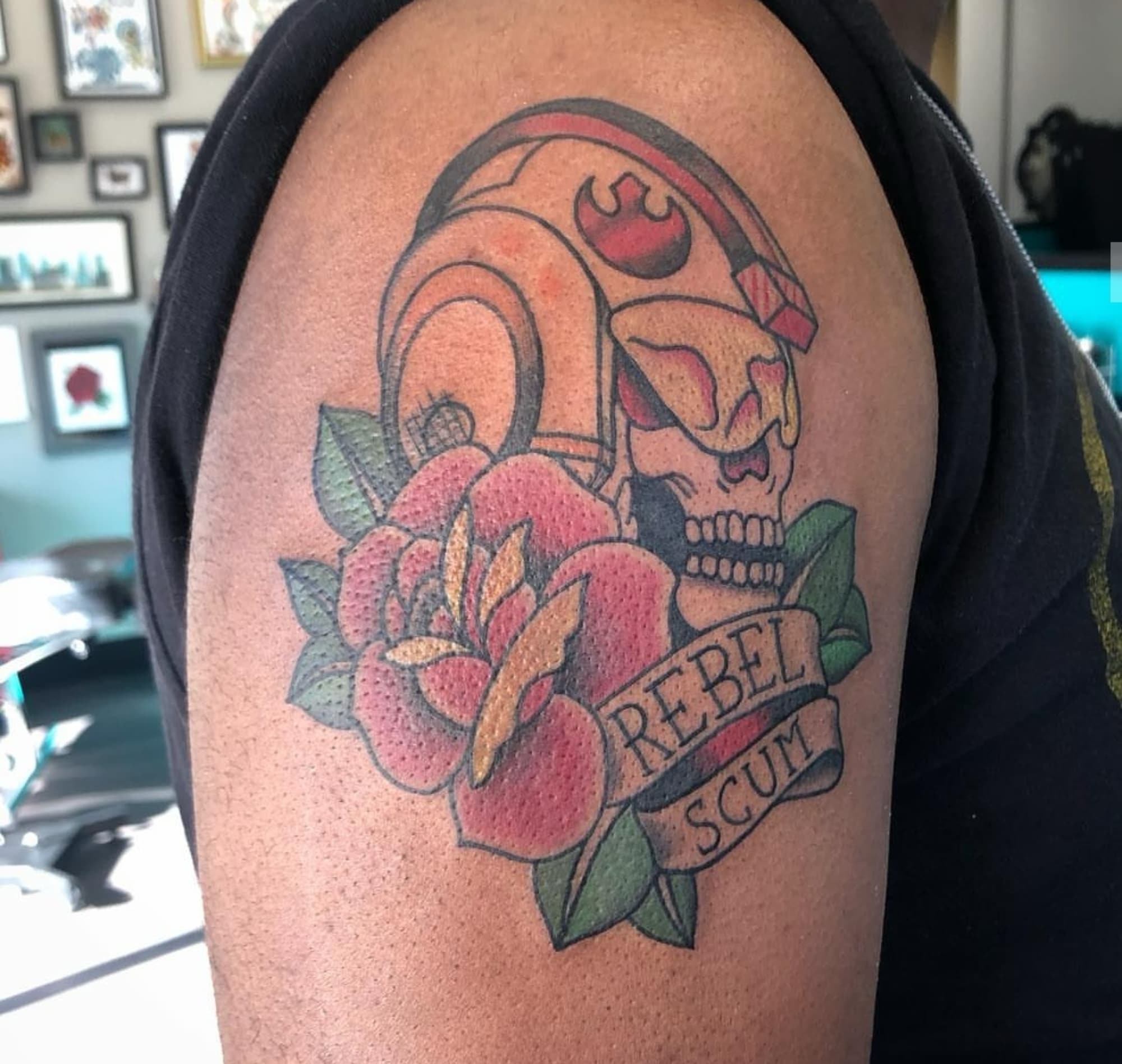
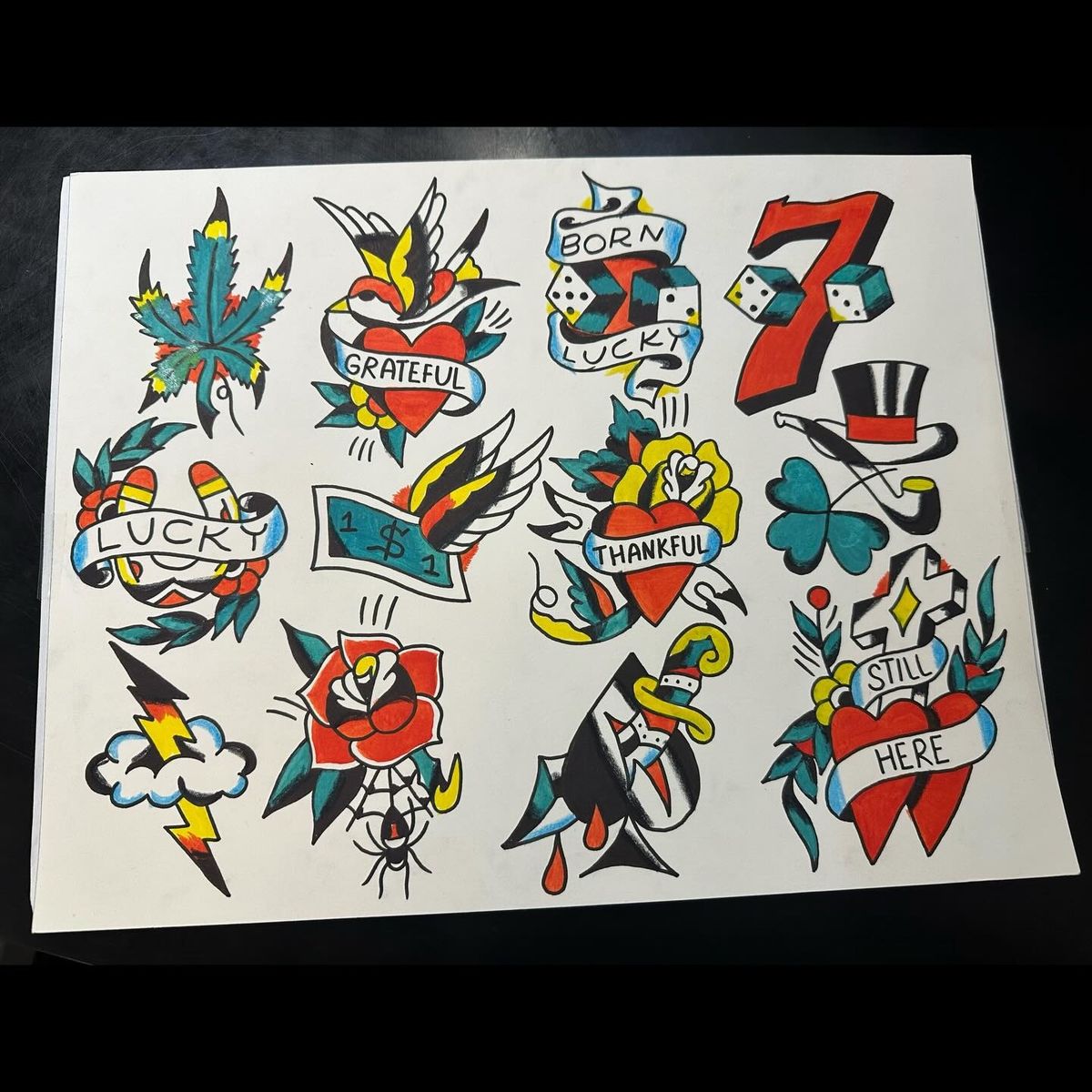

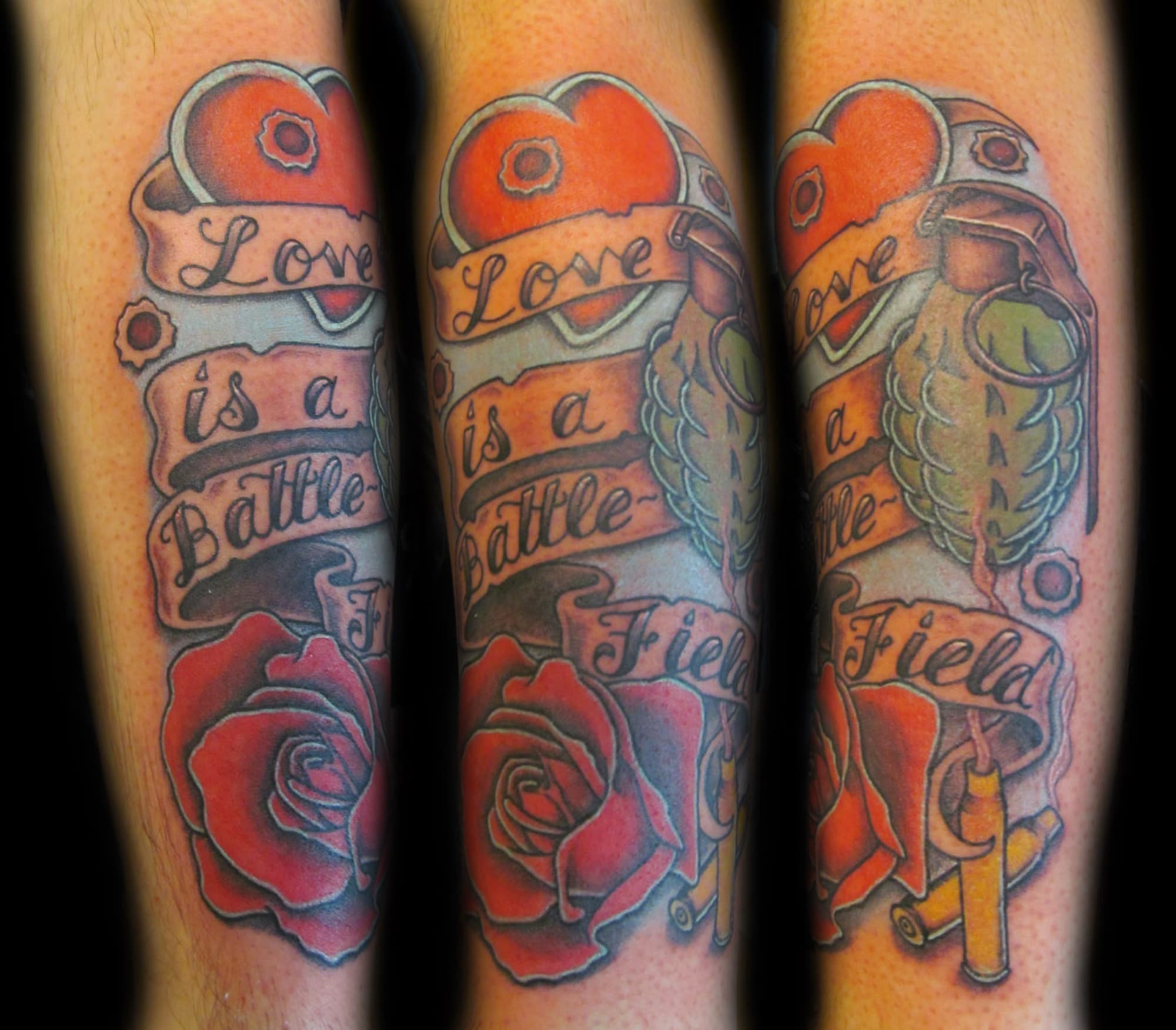
Before Norman Collins set up shop on Hotel Street in Honolulu, American tattooing was a scattered, scrappy trade with no real standard of quality. Collins changed that. Working under the name Sailor Jerry, he built a visual language that defined what most people still picture when they hear the word “tattoo”: thick black lines, punchy color, and designs loaded with meaning. His influence runs so deep in American Traditional tattoos that the two are almost impossible to separate. And while Collins did his work in Hawaii, the style he pioneered belongs to every city with a serious tattoo scene. Walk into Enigma Tattoos in St. Louis on any given week and you’ll see his influence on the flash wall and in the portfolios.
What Are Sailor Jerry Tattoos?
Sailor Jerry tattoos are the backbone of the American Traditional style. They follow a strict visual formula: bold, even-weight black outlines, a limited color palette built on red, yellow, and green, and flat areas of solid color separated by deliberate skin breaks. The designs are built to last decades without turning into muddy blobs, which is why traditional tattooers still swear by the mantra “bold will hold.”
What separates Sailor Jerry’s work from generic traditional tattooing is intention. Every design he created carried specific symbolism, drawn from naval culture, personal experience, and a deep competitive streak that pushed him to keep refining his craft. His pieces weren’t decorative filler. They were statements, each one tied to a real belief or superstition held by the sailors who wore them.
The style sits in contrast to more detailed approaches like realism tattoos or the softer gradients of watercolor work. Sailor Jerry tattoos are graphic, punchy, and designed to read clearly from across a room. That clarity is the point.
Hallmarks of the Sailor Jerry Style
The technical foundation of Sailor Jerry’s work follows a rough rule of thirds: one-third solid black (outlines and shading), one-third color, and one-third open skin. That balance gives each piece its distinctive punch and keeps designs readable as they age.
A few defining characteristics:
- Uniform line weight. Every outline carries the same thickness, creating a bold, graphic quality that holds up over time. No fine-line work, no tapering.
- A restricted color palette. The original Sailor Jerry palette was red, yellow, and brown. Collins later expanded it by developing his own purple ink in collaboration with a laboratory, and added pthalo green and blue. Even with those additions, traditional pieces rarely use more than four or five colors.
- Flat color fills with skin breaks. Color is applied in solid, saturated sections rather than blended gradients. Small gaps of bare skin between the color and the outline create depth and keep elements visually distinct.
- Nautical and military subject matter. Ships, anchors, eagles, and military insignia dominate the catalog. These weren’t random choices; they reflected the lives of the sailors who sat in his chair.
- Readable compositions. Each design is meant to work as a standalone piece at a moderate size. No background clutter, no filler. The image communicates immediately.
This approach shares DNA with blackwork tattoos in its emphasis on bold contrast and graphic clarity, though Sailor Jerry’s palette and subject matter give it a completely different character.
Popular Sailor Jerry Tattoo Designs and Their Meanings
What makes Sailor Jerry designs endure isn’t just how they look. It’s what they mean. Every classic motif in his catalog carries layered symbolism rooted in naval tradition, superstition, and the lived experience of mid-century sailors.
- Anchors are the most stable object in a sailor’s life, making them the natural symbol for what keeps a person grounded. You’ll often see them paired with “Mom” or a partner’s name on a banner, representing the people who hold someone steady when everything else is moving.
- Swallows signal a safe return home. These land-based birds told sailors that shore was close. A single swallow marked 5,000 nautical miles traveled. Pairs of swallows meant 10,000. Folklore also held that swallows carried the souls of sailors lost at sea to heaven.
- Clipper ships represent both the call to adventure and the determination to come home. Collins held master papers on every major type of vessel, and he inked his rigging to be nautically accurate. These weren’t cartoons. They were portraits of real working ships.
- Pin-up girls and lady heads served as the only feminine presence a sailor would see for months at sea. They represent different faces of femininity: the idealized sweetheart, the temptress, the Romany traveler whose nomadic life mirrored the sailor’s own.
- Eagles embody Collins’ complicated patriotism. He loved his country and was deeply critical of it in equal measure. His eagles are fierce and unapologetic, often paired with the flag, representing an idealized America that stands by its convictions.
- Skulls acknowledge mortality head-on. In a world where tattoos belonged to warriors, mercenaries, and adventurers, skull designs were a way of coming to terms with death or staring it down. Common pairings include “Death Before Dishonor” banners.
- Panthers are pure aggression. Collins drew them with bloody red claws and open jaws. They symbolize prowess and raw physical power, a declaration that the wearer isn’t someone to test.
- Snakes, particularly the King Cobra (Collins’ favorite), represent coiled potency. Unlike the panther in mid-strike, the snake waits, ready. It’s a “don’t tread on me” warning.
- Dragons reflect Collins’ complicated relationship with Japanese tattooing. He admired the Japanese masters deeply and was the first Western tattooer to correspond regularly with them, yet he was determined to beat them at their own game. His dragons feel more like exotic spirits than living animals.
- Nautical stars represent the North Star and the idea of never losing your way. Sailors used celestial navigation daily, so this was both practical symbolism and a good-luck charm.
- Pig and rooster tattoos (pig on the left foot, rooster on the right) come from a specific superstition: these animals were kept in lightweight wooden crates on ships, and when vessels wrecked, the crates floated. The animals survived at a surprising rate, making them symbols of luck against drowning.
- Lucky 13 designs flip a bad-luck symbol into a badge of defiance. The series showcases Collins’ sense of humor alongside his design chops, and it reflects a broader tattoo culture tradition of embracing what others fear.
History of Sailor Jerry Tattoos
The bombing of Pearl Harbor in December 1941 turned Honolulu from a quiet port town into a chaotic staging ground for millions of American servicemen. It also turned Norman Collins into Sailor Jerry.
Collins had arrived in Hawaii after years of restless movement. Born in 1911 in Reno, Nevada, he spent his youth hopping freight trains across the country. In Chicago, he apprenticed under Gib “Tatts” Thomas, who taught him to use a tattoo machine and grounded him in the fundamentals of American tattooing. After enlisting in the Navy, Collins traveled through Asia, where he encountered Japanese tattooing traditions that would reshape his understanding of the craft. He studied with Japanese masters, including Kazuo Oguri, learning techniques for large-scale body compositions that were completely foreign to American tattoo culture at the time.
When he settled in Honolulu and opened his shop at 1033 Smith Street, the timing aligned with history. Suddenly, thousands of young sailors on shore leave wanted ink before shipping out to the Pacific theater. Collins gave them designs that matched their swagger: bold, symbolic, loaded with meaning about loyalty, mortality, adventure, and home.
His innovations went beyond design. Collins built improved tattoo machines, created the Mag shader with a Japanese-style needle configuration, and pushed for sanitary standards in an era when needle reuse was common. He also developed the first reliable purple tattoo ink, partly motivated by a rivalry with another artist named Lou Norman.
Collins trained a handful of apprentices before his death in 1973, including Ed Hardy, Mike Malone, and Zeke Owen. He stipulated that one of them must take over his shop or it should be destroyed. Ed Hardy went on to become one of the most recognized names in tattoo history, carrying Collins’ technical innovations into the mainstream. The lineage from Collins to Hardy to the broader American tattoo industry is direct and well-documented.
Getting a Sailor Jerry Tattoo in St. Louis
Finding the right artist for Sailor Jerry-style work means looking for someone who understands the rules of traditional tattooing, not just someone who can copy flash. Portfolio review matters here more than with most styles. Look for consistent line weight across entire pieces, clean color packing without blowouts, and proper skin breaks. An artist who understands the structure behind the style will produce work that ages well and reads clearly for decades.
The tattoo style guides on the Enigma site cover a range of approaches, but traditional work has a special place in the shop’s lineup. If you’re considering a Sailor Jerry piece, a consultation at Enigma is where the design comes together. The process starts with your idea, whether that’s a classic flash design, a motif with personal meaning, or something custom that stays within the traditional framework. From there, our tattoo artists work with you to dial in size, placement, and composition so the final piece hits the way it should.
Placement is worth thinking through. Traditional pieces are designed to work at specific sizes. An anchor that looks perfect on a forearm might lose its impact scaled down to a wrist. Larger compositions like clipper ships or eagles often land best on the upper arm, chest, or calf where there’s enough real estate for the design to breathe. Your artist can walk you through what works for the motif you’re drawn to.
St. Louis has a growing tattoo culture with no shortage of options, but not every shop treats traditional work with the respect it deserves. At a Delmar Loop tattoo shop like Enigma, traditional tattooing isn’t a side offering. It’s part of the foundation.
Sailor Jerry Tattoo FAQ
Are Sailor Jerry tattoos the same as American Traditional?
Sailor Jerry’s work is the foundation of American Traditional tattooing, but the two aren’t perfectly interchangeable. American Traditional is the broader style category. Sailor Jerry refers specifically to the designs, techniques, and philosophy that Norman Collins developed, which then became the template that other traditional artists built on. If you get an anchor in the traditional style, it’s an American Traditional tattoo. If it follows Collins’ specific design language, it’s a Sailor Jerry tattoo.
How well do Sailor Jerry tattoos age?
Better than almost any other style. The combination of thick outlines, solid color fills, and deliberate skin breaks is specifically engineered for longevity. Bold lines spread slightly over time, which actually fills in the design and can make it look even more solid after five to ten years. Traditional pieces done at appropriate sizes are widely considered the longest-lasting tattoo style.
What size should a Sailor Jerry tattoo be?
Most classic Sailor Jerry designs work best at palm-size or larger. The bold lines and flat color areas need enough space to stay distinct. Going too small compresses the elements and can lead to a muddy look as the tattoo ages. Your artist can help you find the right scale for your chosen design and placement.
Can you customize a Sailor Jerry tattoo or does it have to be flash?
Both approaches are valid. Picking a design straight from a flash sheet is the most traditional route, and there’s nothing wrong with wearing a classic as-is. But custom tattoos within the Sailor Jerry framework is equally respected. The key is that the custom piece still follows the structural rules: bold outlines, limited palette, clear composition, and meaningful imagery.
1 thought on “Sailor Jerry Tattoos”