











Somebody walks in with their phone already out. On the screen is a photo of an ear stacked with six or seven pieces of jewelry, and they say some version of “I want this.” Great. The only problem is that nobody knows the names, so we end up standing there pointing at the picture together. That one’s a rook. That’s a flat. The two connected by the bar are an industrial.
Our piercers at Enigma Tattoos have that conversation most weeks, and it never gets old. But it’s a lot easier to plan an ear when you know the ear piercing types by name, what each one’s going to feel like, and how long you’re signing up to take care of it. So here’s all of it, laid out.
[IMAGE: labeled ear piercing diagram — John to add]
| Type | Where It Sits | Pain (1-10) | Healing Time | Starter Jewelry |
|---|---|---|---|---|
| Lobe | Soft, fleshy lower ear | 2-3 | 6-8 weeks | Flat-back implant-grade titanium stud |
| Helix | Upper outer cartilage rim | 4-5 | 3-6 months | Small cartilage stud or clicker |
| Forward Helix | Cartilage ridge closest to the face | 4-5 | 3-6 months | Small flat-back stud |
| Tragus | Small flap over the ear canal | 3-5 | 3-6 months | Small flat-back stud or labret |
| Anti-Tragus | Small bump opposite the tragus | 4-6 | 3-6 months | Small curved barbell or stud |
| Rook | Upper ridge fold above the tragus | 5-7 | 6-9 months | Curved barbell |
| Daith | Innermost fold above the ear canal | 5-7 | 6-9 months | Captive bead ring or clicker |
| Conch | Bowl-shaped center of the ear | 4-6 | 6-9 months | Stud (inner); ring once healed (outer) |
| Snug | Inner rim, mid-ear | 6-8 | 6-9 months | Curved barbell |
| Industrial | Barbell connecting two helix piercings | 6-8 | 6-12 months | Long straight barbell |
| Orbital | Two piercings joined by one ring | 5-7 | 6-12 months | Stud while healing, hoop once healed |
| Flat | Flat cartilage surface of the upper ear | 4-6 | 4-9 months | Flat-back stud with flat disc back |
Every piece of starter jewelry we put in is implant-grade titanium, and it goes in fresh from hospital-grade sterilization. If you want the longer version on materials, gauges and sizing, that all lives over on our piercing jewelry page.
Lobe Piercing
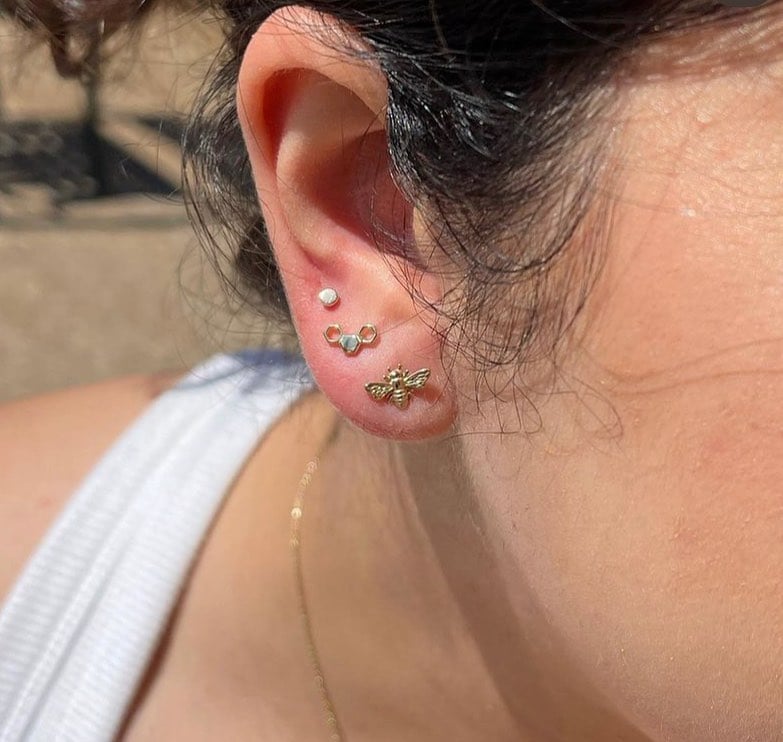
This is where nearly everyone starts, and for good reason. The lobe is soft, fleshy tissue with plenty of blood flow, which is exactly what a piercing wants when it’s trying to heal. No cartilage, no fold, nothing structural to work around.
Getting it done takes about as long as it takes to read this paragraph. You feel a quick pinch, a hot second of pressure, then it’s over. On a ten-point scale most people land at a 2 or 3, and plenty of them say the anticipation was worse than the actual piercing.
Healing runs 6 to 8 weeks, the fastest window on this entire chart. That doesn’t mean you can ignore it for two months. It does mean you’re not signing up for a year of babysitting.
Starter jewelry is a flat-back titanium stud. Flat backs sit against the skin instead of poking into it, so they don’t snag on pillowcases or hoodie strings.
If you’re building toward a stacked ear, open here. It heals fast, it forgives mistakes, and it shows you how your body handles the process before you commit to cartilage.
Helix Piercing
That row of studs curving up the outer edge of an ear? Those are helix piercings. The helix is the upper outer rim, the curved ridge you can pinch between two fingers, and it’s the most common cartilage piercing we do. It’s also where most people go second, right after lobes.
Cartilage feels different than lobe tissue. There’s more resistance, so instead of a quick pinch you get a firmer, slower pressure, sometimes with a small crunch you hear more than feel. Most people put it at a 4 or 5. The piercing itself takes a couple of seconds. The dull throb afterward hangs around longer than it does on a lobe, usually for an evening.
Plan on 3 to 6 months of healing. Cartilage has less blood supply than the lobe does, and that’s the whole reason these timelines stretch out.
We start helixes with a small cartilage stud or a clicker. Hoops look fantastic on a healed helix and cause problems on a fresh one, because they move every single time you brush your hair. Wait for it.
Nervous about your first cartilage piercing? The helix is a solid opening move. Easy to reach, easy to clean, forgiving compared to what’s further down this list.
Forward Helix Piercing
Trace the rim of your ear backward toward your face and you’ll hit a narrow ridge of cartilage right where the ear meets your head. That’s the forward helix. It’s often done as a single, sometimes as a stacked set of two or three climbing that ridge.
Pain lands in the same neighborhood as a standard helix, a 4 or 5, though the sensation is a little sharper because the cartilage there is thin and pulled tight. Your piercer will spend real time marking this one, since a millimeter off on that ridge reads as crooked once the jewelry is in.
Healing runs 3 to 6 months. The tricky part isn’t the tissue, it’s the address. It’s tucked exactly where headphones, sunglasses arms and hair all want to live.
Small flat-back studs are the standard, and “small” is doing a lot of work in that sentence. Anything with a big decorative front will catch on things you never noticed touching your head.
Tragus Piercing
The question on this one is always the same: can you hear it? Yes. And that’s fine.
The tragus is the small flap of cartilage covering your ear canal, so the pressure and the pop happen inside your head in a way no other piercing does. Startling, not painful. Rated on its own it comes in at a 3 to 5, on the lower end of cartilage. The sound is what people remember, not the sensation.
Give it 3 to 6 months. The tragus is a small, dense piece of cartilage and it heals well, as long as you keep phones, earbuds and unwashed hands off it. Earbuds are the real enemy here. If you live in them all day, factor that in before you book.
Standard starter jewelry is a small flat-back stud or labret, sized short so it isn’t pressing into the canal.
Alongside lobes and helixes, this is one we’re happy to recommend as a first cartilage piercing. It’s contained, it’s easy to keep clean, and the healing curve is reasonable.
Anti-Tragus Piercing
Directly across the notch from the tragus, a smaller bump of cartilage juts up off the top of your lobe. That’s the anti-tragus, and whether you can get one depends heavily on your anatomy. Some ears have a pronounced ridge there. Some barely have one at all, and nobody here is going to force jewelry into tissue that can’t support it.
Assuming you’ve got the ridge, expect a 4 to 6. The cartilage is dense and the angle is awkward, so it’s a firmer push than a helix, and the soreness afterward is more noticeable the first few nights you sleep on that side.
Healing takes 3 to 6 months, and this one gets bumped a lot. It protrudes slightly, which makes it a magnet for hairbrushes and phone screens.
A small curved barbell or a stud goes in first, curved usually winning because it follows the shape of the ridge.
Honest read: this isn’t a difficult piercing, but it’s one where we’ll actually look at your ear before promising anything. Come in, let someone check the ridge, go from there.
Rook Piercing
“I want the one that goes through the fold up top.” We hear that a lot, and nine times out of ten the person is describing a rook. It runs horizontally through the ridge of cartilage that folds over above the tragus.
Folds over is the key detail. The needle passes through two layers of cartilage instead of one, so it’s a longer, more deliberate push than anything above it on this list. Call it a 5 to 7. This is the first placement on the chart where people tend to grip the arm of the chair.
Healing runs 6 to 9 months. Thicker tissue, a tucked-away location and a curved piece of jewelry add up to a slow, moody heal. Irritation bumps are common on rooks, and most of the time it’s normal and it settles with time and clean hands, not with panic. If something looks off to you, come show us. That’s what we’re here for.
A curved barbell is the standard starter, matching the natural curve of that fold.
We love a good rook. We just don’t love it as somebody’s first cartilage piercing. Get a helix or a tragus through a full heal first, then come back for this.
Daith Piercing
The daith is the innermost fold of cartilage, the little shelf curling over your ear canal. Getting it done is a strange experience, mostly because of how deep in the ear it happens. Pressure builds, then releases. Most people rate it a 5 to 7, and sitting that close to the canal makes it louder than it is painful.
Now the part everybody asks about, because it usually isn’t the look that brings them in. There is no medical evidence that a daith piercing treats migraines. It’s a story that spread widely and stuck around. If you want one because it looks incredible, that’s a great reason to get one. Don’t get one as a treatment plan.
Set aside 6 to 9 months. It’s a tight, hard-to-reach spot, cleaning it is a genuine chore, and the jewelry sits where hair product and moisture like to collect.
A captive bead ring or a clicker goes in first. The daith is one of the few placements pierced with a ring from day one.
Commitment piece. Worth it if you want it, not where we’d point a first-timer.
Conch Piercing
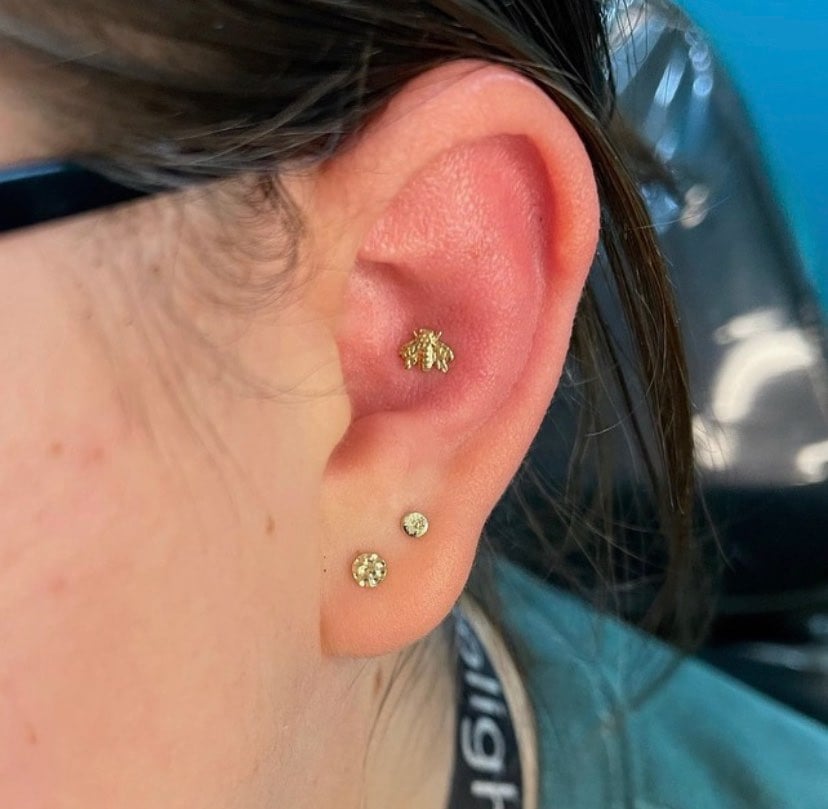
Named for the shell it resembles, the conch is the wide bowl in the center of your ear. It comes in two versions: inner conch, which goes through the cupped area near the canal, and outer conch, which sits higher and flatter, just under the helix rim.
The tissue there is broad and even, which makes the piercing itself fairly straightforward. Pain generally comes in at a 4 to 6, a thicker push than a helix but without the awkward angle of a rook.
Budget 6 to 9 months. The conch is a big piece of cartilage and it takes its time. Sleeping is the main complaint, since a conch sits right where your ear meets the pillow. A travel pillow with a hole in the middle is the single best purchase anybody makes after this piercing, and we recommend it constantly.
Starter jewelry is a stud for an inner conch. An outer conch can eventually carry a ring that hugs the rim, but that comes after it’s fully healed, not on day one.
Snug Piercing
Anatomy is the gate on this one. Plenty of ears don’t have a ridge deep enough to hold a snug safely, and a forced snug is a rejected snug, so this is a placement somebody needs to look at before anybody promises you anything.
The piercing itself runs horizontally through the inner rim of cartilage in the middle of the ear, above the anti-tragus. That ridge is shallow, dense and short, so the needle travels through a lot of tissue in a very small space.
Then there’s the pain, and we’re not going to soften it. The snug is the most consistently painful piercing on this chart, and no honest piercer is going to tell you otherwise. People put it at a 6 to 8, and unlike a lobe, the sensation doesn’t vanish the second the needle is out.
Expect 6 to 9 months, and expect it to be opinionated the entire way through. Snugs swell more than most, so your piercer will fit a longer curved barbell up front and downsize it once the swelling drops.
Curved barbell to start, downsized later. A snug is a stunning piercing, and it’s also the one we’re most likely to ask you to wait on if cartilage is new to you.
What we see most in the Loop: Most people start with a lobe or a helix, and a lot of them come back for a tragus or a conch once they know how their ears heal. Snugs and industrials get asked about more than they get booked, usually once somebody hears the healing timeline. That’s not us talking anybody out of anything. It’s just what a year of aftercare actually asks of you.
Industrial Piercing
One long barbell running across two holes at the top of the ear. That’s an industrial, and it’s really two helix piercings, one forward and one back, connected by a single straight bar.
Two piercings means two of everything: two moments of pressure, two healing sites, two chances for something to get irritated. Most people rate the experience a 6 to 8, and the second one always feels sharper than the first, because now you know what’s coming.
Not every ear has the geometry for this one. The two points have to line up on a straight axis, and if yours don’t, a piercer who tells you no is doing you a favor.
Healing takes 6 to 12 months, the long end of this chart, because the two sites are physically tied together. Bump one and you’ve bumped both. Sleeping on it, pulling a shirt over your head, tying your hair back, all of it moves the bar.
The starter is a long straight barbell, sized with room for swelling.
Plainly: an industrial is not a first piercing. It’s the one you get after you’ve proven to yourself that your ears heal cartilage well.
Orbital Piercing
People mix this one up with the industrial constantly, so here’s the difference. Both connect two holes. An industrial uses a straight bar spanning two separate parts of the ear. An orbital uses a ring looping through two holes made close together in the same area, most often the lobe or the outer helix, so the jewelry orbits a small piece of tissue.
Two piercings, so figure a 5 to 7 depending on where it goes. On the lobe it’s much closer to easy. Up in cartilage it climbs.
Cartilage orbitals heal in the 6 to 12 month range, for the same reason industrials do. Two wounds joined by one piece of jewelry that moves as a unit.
Most piercers, us included, start an orbital with two separate studs and swap in the connecting hoop once both holes are healed. Less romantic than walking out with the finished look, and it’s the reason your orbital will still be there in two years.
Flat Piercing
Say you love the look of tiny studs scattered across the upper ear, the ones that seem to float. Those are flats. The flat is the broad, level plane of cartilage between the helix rim and the inner ear, and it’s called that because it is, genuinely, flat.
Pain runs 4 to 6. The cartilage there is thicker than the helix rim, so it’s a firmer push, but the area is easy for a piercer to access and easy for you to reach when you’re cleaning it.
Healing gets quoted at 4 to 9 months, a wide range because flats vary a lot depending on how many you get and how thick your cartilage is. One flat heals faster than three flats in a row. Basically, the more you stack at once, the longer the whole project takes.
Jewelry is a flat-back stud with a flat disc back, which is exactly what it sounds like and exactly why these sit so cleanly against the ear.
Questions We Get Asked Every Week
What is the most painful ear piercing?
Snug and industrial, both at 6 to 8, with rook and daith close behind at 5 to 7. All four go through dense or doubled-over cartilage. Pain tolerance is personal, though, and people who swear the rook was nothing will also swear a lobe hurt.
What is the least painful ear piercing?
The lobe, at a 2 to 3. Soft tissue, no cartilage, done in about a second. It’s why almost everyone’s first piercing is a lobe.
How many types of ear piercings are there?
Twelve standard placements, the ones on this chart. Piercers do combine and stack them into named looks, so you’ll see higher counts elsewhere depending on how somebody’s counting variations.
How long does a cartilage piercing take to heal compared to a lobe?
A lobe closes up its healing in 6 to 8 weeks. Cartilage runs 3 to 12 months depending on placement, which means the shortest cartilage heal is roughly twice as long as a lobe, and the longest is closer to eight times.
Why is cartilage riskier than the lobe?
Blood supply. Lobe tissue is fleshy and well-fed, so it repairs quickly. Cartilage is dense with limited circulation, so it heals slower and has a harder time fighting off irritation when something goes wrong. Same reason cartilage holds a grudge about being bumped.
Piercing gun or needle for cartilage?
Needle, always. Guns force blunt jewelry through tissue with pressure instead of cutting a clean channel, and they can’t be sterilized the way a single-use needle can. That’s damaging on a lobe and worse on cartilage. We don’t keep a gun in the building.
What jewelry should I start with, and when can I switch to hoops?
Start with whatever the chart above lists for your placement, in implant-grade titanium. Hoops wait until the piercing is fully healed, not just feeling fine. Moving jewelry is the number one cause of a heal that drags on for months.
Can I get multiple ear piercings done in one session?
Usually, yes. Two or three lobes at once is routine. Stacking several cartilage piercings in the same session is where we start asking questions, because you have to sleep somewhere, and every fresh site needs its own care. Walk-ins are welcome if you want to come talk it through first.
Does a daith piercing really help migraines?
No evidence supports it. It’s folklore that got repeated enough to sound like fact. Get the piercing because you like it.
What’s the difference between an orbital and an industrial?
An industrial is a straight bar spanning two points across the ear. An orbital is a ring looping through two holes side by side in one spot. Easy to confuse, completely different jewelry.
Healing, In Short
Whatever you get, the rules are the same and they’re not complicated.
- Clean it with sterile saline twice a day.
- Leave it alone the rest of the time. No twisting, no picking, no rotating.
- Don’t swap the jewelry early, no matter how good it feels.
- Sleep off of it as best you can.
- Give it the full timeline on the chart, not the point where it stops hurting.
A little redness or a small bump is usually nothing, and it settles on its own. If you’re worried, don’t sit at home googling it. Call the shop.
Ready to actually get one? Our piercers work out of the Delmar Loop, walk-ins are welcome, and every placement on this chart is something we do. Pricing, hours and booking for ear piercing in St. Louis are all on the service page, and if you’re eyeing something beyond the ear, our full range of piercing services covers the rest. Still not sure what you want? That’s normal, and it’s a good reason to get in touch. Bring the screenshot. We’ll name everything on it.